The Three Cultures Route
Route of the Three Cultures
During the Middle Ages, the three great monotheistic religions coexisted in Tortosa: Christianity (dominant since the conquest in 1148), Islam (which had controlled the city between the 8th century and the mid-12th century) and Judaism, whose presence is documented from at least the mid-5th century. Although the Jewish community was not very numerous compared with the other two, it maintained remarkable cultural and economic vitality.
This route allows visitors to discover the most important elements that the city preserves from this significant historical period and from the cultures that developed here.
1. The Jewish Quarter (Call)
It is located in the Remolins district and still preserves much of the original urban layout of its streets, despite the centuries that have passed since the expulsion of the Jews at the end of the 15th century. The route begins in Menahem Ben Saruq Square, located next to the Célio tower. The square is dedicated to a distinguished writer and grammarian of the Andalusi period who lived in Caliphal Córdoba in the 10th century.
If we follow the medieval wall, we reach the Portal dels Jueus or Portal del Ferro, which connected the Jewish quarter with the cemetery of the Jewish community. Along this route it is also worth visiting Vilanova Street, notable for its straight layout, unusual in medieval streets, resulting from a 14th-century urban reform intended to dignify the heart of the New Jewish Quarter.
Around the main street of Remolins, which divided the Old Jewish Quarter (on the river side) from the New Quarter (on the mountain side), there are evocative spaces such as the medieval House of Sant Jordi, long believed to be the synagogue (although it was actually a medieval hospital), and the Terrisseria area. In the Old Quarter were the main communal facilities of the Jewish community: the synagogue, the communal bakery and the butcher’s shop. Unfortunately these buildings have disappeared, although their location is known thanks to historical documentation.
2. The Moorish Quarter (Moreria)
This was the district where the Islamic population that remained in the city after the Christian conquest was concentrated. Although much of it disappeared during the Reapers’ War in the 17th century, a small sector still survives near the former Portal de l’Assoc.
3. Walk of the Cultures
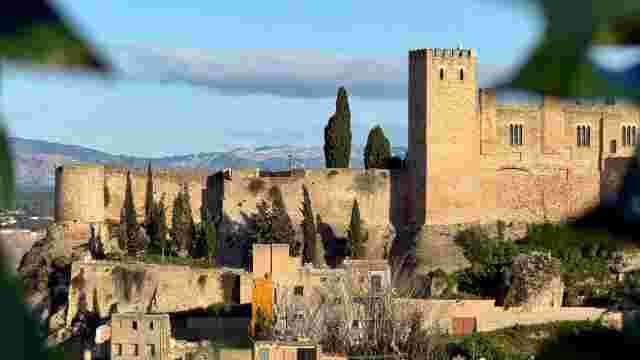
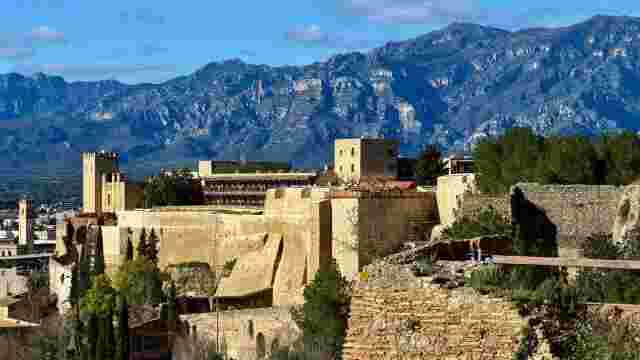
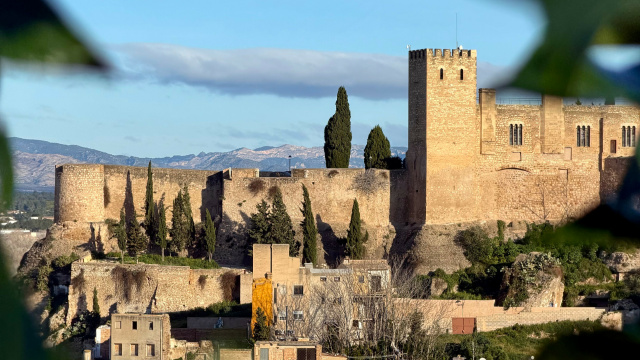
Located at the foot of the Castle of La Suda, at the summit of which visitors can see the only Andalusi necropolis in Catalonia. This itinerary features figures created by the artist Ignasi Blanch that represent important characters from the history of Tortosa. From the medieval period, notable figures include Ben Saruq, Abu-Bakr, the notary, merchants, the legend of the Order of the Axe and the Moriscos. The visit concludes at Sant Jaume Square, where murals dedicated to the Three Cultures and the Llibre de les Costums, one of the earliest legal texts written in Catalan, can be seen.
4. Municipal Museum
Among its collections are several archaeological pieces from the Andalusi period (with an important ceramic collection) and medieval objects such as a fragment of a Hanukkah lamp, the 1492 decree of expulsion of the Jews, and remains of a Gothic boundary cross.
5. Cathedral of Santa Maria
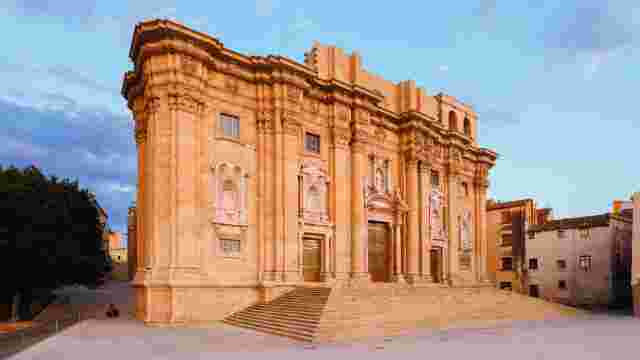
Located in the heart of the historic centre, it is undoubtedly the most important monument in Tortosa. Within its walls there is a rich collection of artistic expressions that go beyond architecture and include sculpture, painting and decorative arts.
The current Gothic cathedral began to be built in the mid-14th century to replace an earlier Romanesque one consecrated in 1178, which had become too small for the growing population. Construction began with a monumental apse that incorporated the old Romanesque one, allowing worship to continue while the new cathedral was being built. Despite difficulties such as the Black Death of 1348 and the later economic crisis, the works progressed and by the mid-15th century the new temple was partially consecrated.
Inside the presbytery stands the magnificent main altarpiece dedicated to the Virgin of the Star, created in the second half of the 14th century. The cloister, built in the 13th century, and the permanent exhibition of sacred art preserve exceptional pieces such as the Last Supper tapestry (15th century), the Transfiguration altarpiece by the Vergós family, the trilingual Jewish funerary slab (6th-7th centuries) and the foundation stone of the Caliphal shipyards of Turtuxa (10th century).
The famous Disputation of Tortosa (1413–1414), a theological debate promoted by Pope Benedict XIII, known as Pope Luna, also took place here. It aimed to demonstrate to the Jewish community the supposed falseness of their religion compared with Christianity and marked the beginning of the decline of Jewish communities in the Crown of Aragon.
6. Episcopal Palace
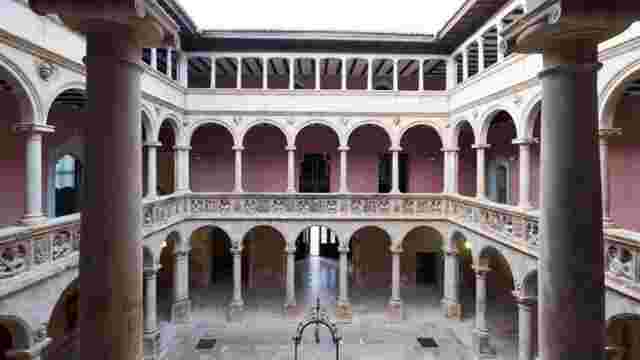
The structure, size and noble spaces of the building clearly demonstrate the historical importance of the Diocese of Tortosa during the Middle Ages. The palace is organised around a large central courtyard. The most remarkable space is the chapel, covered by an elegant vault and decorated with sculptures of saintly bishops and a Virgin with the Child surrounded by angels. Much of the original polychromy has been preserved.
7. Gothic City Fountain
Reconstructed in the second half of the 20th century using original pieces from the 15th-century fountain. Notable features include the municipal coat of arms supported by two angels and a curious ventilator with spiral tracery.
8. Rosa Street
For centuries it was one of the most aristocratic streets in the city. Two interesting Gothic houses remain: the Oriol Palace and the Despuig Palace. The latter is particularly notable for its courtyard with a lateral staircase, a decorated doorway and a gallery of arches supported by slender stone columns.
9. Portal dels Romeus
This former city gate was crossed by a branch of the Ebro Way of St James. Its most remarkable features are the monumental reliefs of Saint Christopher and Saint James, protectors of travellers. Nearby, inside the Marcel·lí Domingo Library, archaeological remains of a small sector of the Islamic city of Turtuxa can be seen beneath a glass floor.
10. Convent of Santa Clara
Founded in the 13th century, it still preserves much of its original monastic atmosphere despite the severe destruction caused in 1936 at the beginning of the Spanish Civil War. Its Gothic cloister, elegant and slender, is particularly noteworthy. It is the only part of the monastery open to visitors, as the convent is still inhabited by a cloistered religious community.