Route of the Royal Colleges and the Renaissance
Route of the Royal Colleges and the Renaissance
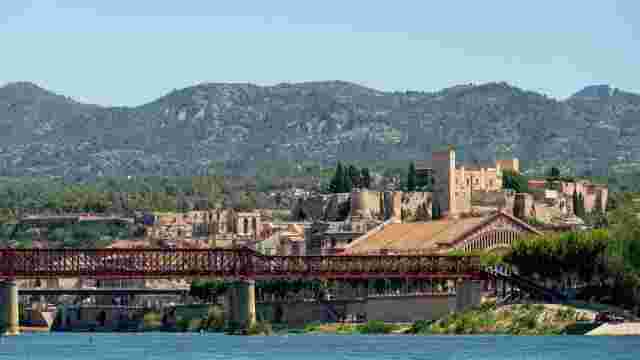
This route allows us to discover the Renaissance legacy preserved in the city of Tortosa. Its privileged geographical location and the fertility of the Ebro Valley, magnificently described by Cristòfor Despuig in Los Col·loquis de la insigne ciutat de Tortosa, written by the author around 1557, provided a very favorable starting point for the economic and social development of the most important urban center of that time in southern Catalonia.
The itinerary begins at the end of Sant Domènec Street, where we find the finest architectural ensemble of the Catalan Renaissance: the Royal Colleges. The origins of these two educational centers can be traced back to the Dominican friar Baltasar Sorió, who, starting in 1523, sought to convert the old Lectoria House of the Cathedral into a college to train friars of his order. In 1534, the first one was created, dedicated to Saint George and Saint Dominic, as a center of Arts and Theology studies for Dominicans. In 1544, the process began to create the second college, dedicated to Saint James and Saint Matthias, with the aim of educating the Morisco children in the Christian faith, also with Dominican teachers.
- The Royal College of Saint James and Saint Matthias
This building represents, without a doubt, the finest architectural ensemble of the Catalan Renaissance, both for its stylistic homogeneity and for its magnificent courtyard, which is wonderfully preserved. In the center of the façade, there is a monumental pyramidal structure with three levels, resembling an altarpiece. At the lower level, there is a semicircular arch with two attached Corinthian columns. The entablature features classical elements. On the second level, the Habsburg coat of arms with the double-headed imperial eagle is placed beneath a triangular pediment supported by two figures. At the top, there are three statues of saints: the two titular saints of the College and the Guardian Angel.
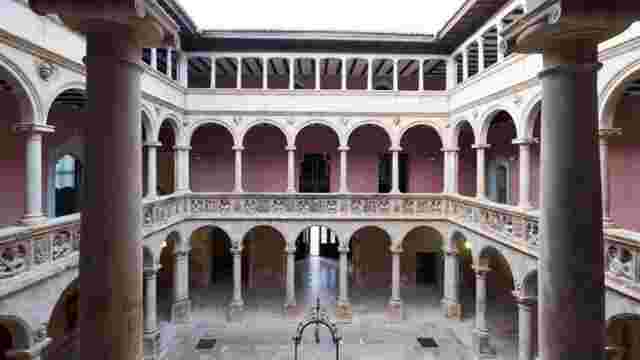
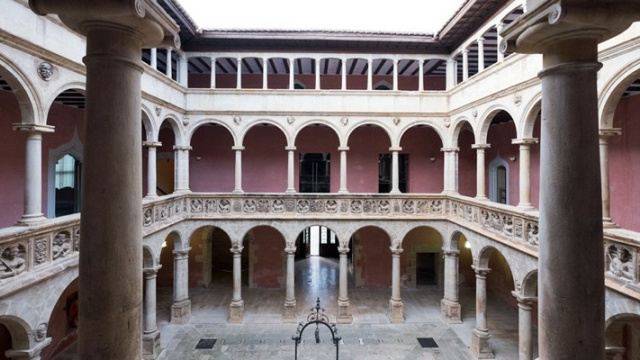
The interior courtyard is the most interesting architectural feature of the Royal Colleges. It has a square plan with three levels of galleries supported by columns. The most characteristic decorative element of this courtyard is the frieze on the second gallery, where the busts of royal couples are represented, from Ramon Berenguer IV, conqueror of the city, and Péronelle of Aragon, to Philip II and Maria of Portugal. It was made between 1563 and 1564 by the Burgos-born sculptor Francisco de Montehermoso. In addition to this royal frieze, the courtyard also features Morisco busts on the ground floor, an apostolate on the first floor, and the four winds in the corners of this same level. - The Royal College of Saint George and Saint Dominic
The entrance portal to the Royal College and the Church of Saint Dominic are noteworthy. As for the former, it is also known as the Domus Sapientiae (House of Wisdom), due to the inscription on the architrave of the portal, as this building was a university between 1600 and 1717, first pontifical and later royal. The date 1578 is engraved on it. The patio or cloister was rebuilt in the 1960s, as the original one, built in the early 17th century, was damaged by the bombings of the last Civil War. The reconstruction sought to reproduce the original elements as faithfully as possible. - Church of Saint Dominic
This is a magnificent example of a church that masterfully blends Renaissance elements (the portal, certain decorative details, etc.) with Gothic ones, such as the vault system of the roof and the choir. It was built under the direction and supervision of the architect Martín Garcia de Mendoça between 1585 and 1595. The portal is designed as a classical triumphal arch, with large side columns, and glorifies the memory of Bishop Joan Izquierdo, the promoter of the works.
The interior of the church, very bright and dominated by vertical lines due to the absence of pillars or columns, clearly showcases the best qualities of the Catalan Gothic tradition, with unitary spaces covered by ribbed vaults.
Inside, we find several interesting pieces: first, on the floor, the carved tombstones featuring the effigies of the two people who promoted the works of this Royal College: Friar Baltasar Sorió and Dominican Bishop Joan Izquierdo.
In the chancel, we can see the old archive cabinet of the City House, dating from 1574, with paintings on the inside of the doors. On one side of the church, there is also a remnant of the old City House: a stone portal built in 1572, with the curious depiction of a skull as a reminder of the brevity of life.
Inside this former church, the Renaissance Interpretation Center operates, offering an interesting insight into this historical period. It also explains why the city organizes each year, on the third weekend of July, the Renaissance Festival, a major historical reenactment event centered around this era. During the days of the festival, the streets of the city are decorated, there are shows, parades, Renaissance-themed menus in restaurants, markets with various products, and taverns recreating the ambiance of the time. This festival has become one of Tortosa’s main tourist attractions. - The Cathedral
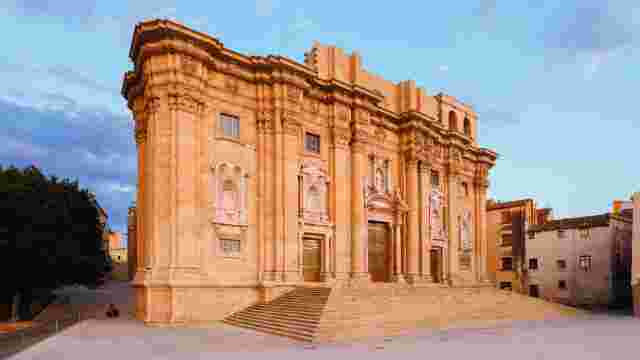
A large part of the naves was built during the second half of the 16th century, and it also preserves some very interesting Renaissance artworks. For example, the Chapel of the Holy Name of Jesus, built in the early 1570s under the direction of the Basque master Joan de Sobralde and with the financial support of Bishop Martín de Córdoba y Mendoza.
Later, the bishop ceded the chapel to the beneficiaries of the Cathedral, and they had a polychrome wooden altarpiece made, which combines a classical structure with wooden carvings placed in niches. Several artists contributed to its construction, such as the carpenter Gabriel Sit, who built the altarpiece's structure following a design by Sebastiano Serlio. The altarpiece is decorated with a series of sculptural figures (a Calvary and the Four Evangelists).
From the late 16th century, the Cathedral preserves a unique object in the artistic panorama of Catalonia: the Renaissance grille of the presbytery. It was originally used to close off the main altar area, but was relocated to the foot of the naves in the early 1970s. Promoted by Bishop Gaspar Punter, it was made in Girona in 1593, with a wooden core, iron plates, and bronze elements. It features exquisite Renaissance decoration on the pilasters. Above the main door, there are two opposed volutes supporting a vase, and in the central upper part, two winged mythological creatures hold the coat of arms of the bishop who commissioned the work.
To conclude the visit to the Cathedral, we must mention the largest Renaissance furniture piece in Catalonia: the old choir stalls, which were relocated at the end of the Civil War to the former dormitory of the canons and are now part of the permanent sacred art exhibition of the Cathedral. They were made from oak wood brought down the Ebro River from the forests of Navarre between 1578 and 1593, by the sculptor Cristóbal de Salamanca and his workshop. They feature a spectacular and varied set of wooden reliefs, combining figures of saints with vegetal and geometric decorative elements. - Oliver de Boteller Palace
It retains a monumental façade built with finely hewn ashlar stones and presents an austere and massive appearance, with a strong dominance of the wall over the openings. It was built in the early 16th century by Lluís Oliver de Boteller, the founder of one of the most important lineages in Tortosa at the time. His economic power was based on controlling the salt trade in the Delta. It was the largest urban palace in the city and hosted, among others, King Philip II when he stayed in Tortosa at the end of 1585. - House of the Diputació del General
This is a stately building, constructed from Flix stone between 1576 and 1578. It served as the residence of officials in the service of the Generalitat, where certain taxes were collected, including those on cloth. It was the first Generalitat house built in Catalonia and served as a model for others built in different cities. - Despuig Palace
Although it was probably built in the 15th century, it is important because it was the residence of the nobleman and writer Cristòfol Despuig (1510-1574). A privileged witness of Tortosa in his time, he is the author of one of the most outstanding literary works of the 16th century in Catalan: Los Col·loquis de la insigne ciutat de Tortosa (1557), in which he vividly describes the urban life of Renaissance Tortosa.