Baroque Route and Holy Week
Baroque Route and Holy Week
During the Baroque period, the city of Tortosa, despite some moments of crisis (caused mainly by the effects of the Reapers' War (1640-1651) and the War of Succession (1705-1714)), experienced a time of strong artistic and monumental momentum. Although in the first half of the last century, a significant part of this artistic heritage (mainly religious in nature) suffered major losses, today we can still enjoy an important local Baroque artistic heritage, with some unique examples in the Catalan landscape.
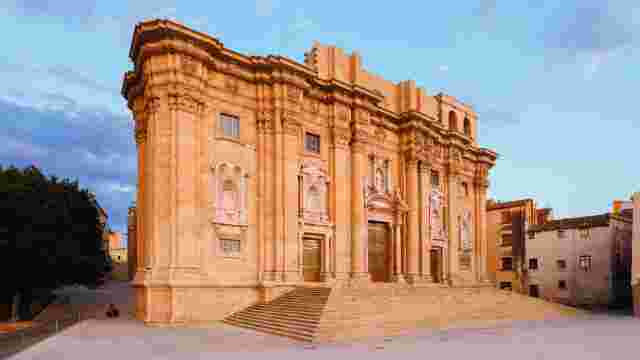
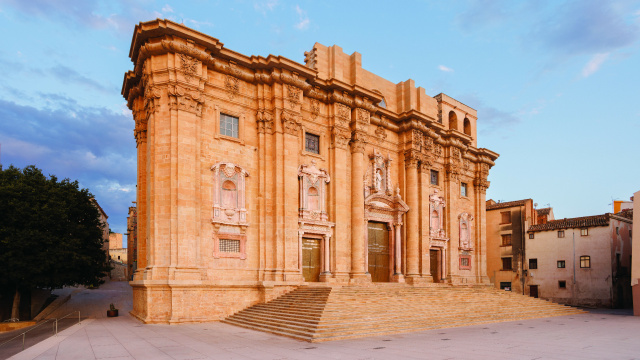
- This route begins at the façade of the Cathedral. It was built between the 1630s and the mid-18th century, with long interruptions caused by wars. Although the initial project is attributed to Martí d’Abària, the long construction process, which lasted more than 120 years, led to some changes in the final result. Despite being unfinished, it resulted in the widest façade of the Catalan cathedrals, designed closely following the principles of Italian Baroque, from which it directly draws inspiration. It features five sections. Above the three doors (one for each nave) and the two side windows, there are five niches designed to house monumental sculptures. Only the central one holds a modern marble figure of the Virgin of the Ribbon. This façade, as we see it today, is wider than it is tall due to the incomplete upper elements, such as the two projected towers. However, it stands out for its monumental entablature decorated with classic-inspired vegetal motifs and the polychromy of the most prominent architectural elements, such as the jasper columns from Tortosa (a local stone material used in many Baroque buildings across the Iberian Peninsula and Italy) and the various colored marbles.
- Royal Chapel of the Virgin of the Ribbon. This Marian devotion has medieval roots through the veneration of its relic: a ribbon given, according to tradition, by the Virgin herself to a priest in 1178. However, due to historical upheavals, it was not until 1672 that the construction of the large Baroque chapel began. The construction was directed by architect Diego Martínez, who had participated in the building of the Chapel of Our Lady of the Forsaken in the city of Valencia, following the project of an author still unknown. In 1715, the Valencian painter Dionís Vidal began painting the vaults, although his sudden death allowed him to complete only the first section, located above the chapel’s presbytery. The rest of the vaults and the dome were painted by his disciple, Josep Medina. On October 17, 1725, in the midst of a grand public celebration in the streets of the city, the chapel was officially inaugurated with the celebration of the first mass at its altar. It wasn’t until the early 19th century that the definitive altarpiece in marble and jasper was created, commissioned in 1822 and inaugurated in 1825. The result of these nearly two and a half centuries of efforts is truly magnificent: a rectangular chapel with a nave divided into two sections, a shallow transept, and a rectangular chancel. All the walls are adorned with jasper pilasters from Tortosa on a high base, with fluted shafts and composite capitals. The walls and vaults of the chapel feature varied pictorial decoration: frescoes on the ceilings and oil paintings on the first two sections of the nave and the side walls of the transept. In the chancel area, there is a complete sculptural work in white marble with the figures of Saint Peter and Saint Paul accompanying the Virgin of the Ribbon as she descends to give her belt. Beyond the chapel, the Cathedral boasts a magnificent collection of Baroque wooden altarpieces, notably those dedicated to the Rosary, in Rococo style, or to Saint Joseph. Also worth mentioning is the Sacristy, dating from the second half of the 18th century.
- The Olivera Gate. Built at the beginning of the 18th century, its curious name comes from the fact that a wild olive tree grew above the arch of the old gate. The structure of the gate closely resembles the altarpieces of that time, with the addition of various sculptures: Saint Candia and Saint Cordula on the sides, and the Virgin of the Ribbon with Saint Peter and Saint Paul above the entablature.
- Old Hospital of the Holy Cross. Built during the 18th century, replacing the old medieval hospital that was demolished due to the wars, it features a magnificent portal adorned with sculptures at the top.
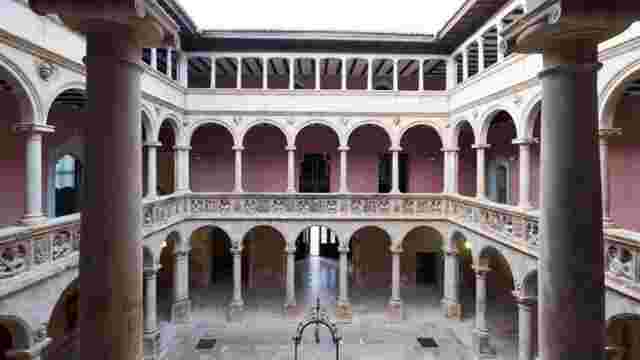
- Saint John’s Square. It takes its name from the existence of a female convent of the Order of Saint John of the Hospital, popularly known as the Rapita Monastery, as it was initially located in that town in the Delta. Despite the significant modifications the building has undergone, the old cloister and the magnificent stone portal, with Rococo decorations typical of 18th-century works, are worth highlighting.
- Montcada Street. It was one of the most important urban arteries in the old center of Tortosa; until the last Civil War in 1936-39, it had up to four Baroque churches. Some suffered severe damage during the war. The Seminary Church was completely destroyed, and the Church of Sorrows only retains some parts (remains of the portal and side chapels), which are now integrated into a square.
- Old Convent of the Immaculate Conception Victory. This convent was founded in the mid-17th century by the Italian Bishop Battista Veschi, who was appointed prelate of Tortosa during the tumultuous years of the Reapers' War. From 1652 onwards, an expansion of the first convent began, resulting in one of the best examples of a 17th-century Baroque church in southern Catalonia, with some works of art imported from Italy.
The image of Christ is particularly noteworthy, a highly venerated figure in the city. It was sculpted by the Franciscan friar Humile da Petralia, who carved it in Palermo in 1635. The sculptor's effort was mainly focused on representing the crucifixion, which he depicted with great realism, pathos, and spiritual force, characteristic of the Counter-Reformation. Thus, this is one of the finest examples of Italian Baroque religious sculpture in Catalonia.
As for the main stone altarpiece (a unique piece in Catalonia), it was possibly made in Genoa, with marbles of various origins and colors, forming a monumental classicist architectural structure. At the base of the altarpiece, the founder bishop’s coat of arms is clearly visible. In a side chapel of the church, also made of marble, lies the tomb of the founding bishop. Finally, on the side walls of the presbytery, there are two large oil paintings representing the Adoration of the Shepherds and the Adoration of the Magi, both from the Neapolitan painting workshops of the mid-17th century. The second one is notable as a copy of a painting by Artemisia Gentileschi, the original of which is in the Cathedral of Pozzuoli.
- Old Church of Saint Anthony. Built in the mid-17th century, it was the seat of the Brotherhood of Farmers in the city. It suffered severe damage during the last Civil War. In 2011, its interior underwent a radical transformation to become a museum space dedicated to the Holy Week of Tortosa. This space showcases the 11 processional floats and various elements related to the processions and brotherhoods. This religious festival has its own unique characteristics in the city compared to other places in Catalonia. For example, the most crowded procession is on Palm Sunday, where all the floats from the various brotherhoods parade, some of which have existed for centuries, such as the Farmers' Brotherhood, the Brotherhood of the Immaculate Blood, or the Brotherhood of Sorrows. Also notable is the emotional Procession of Silence on Holy Thursday evening, and the Holy Burial Procession on Good Friday.
- Church of Saint Blaise. Initially, this was the temple of the Trinitarian friars' monastery. Despite the significant destruction it suffered during the last Civil War, its façade remains in good condition, with a stone portal built, according to the inscription, at the end of the 18th century (year 1784), which may explain its clear neoclassical lines.